If you already own a home in Perth and you’re thinking about buying an investment property, the deposit question usually comes up before anything else. Lenders don’t treat investment loans the same way they treat a loan for the home you live in, and that changes how much you need to put down.
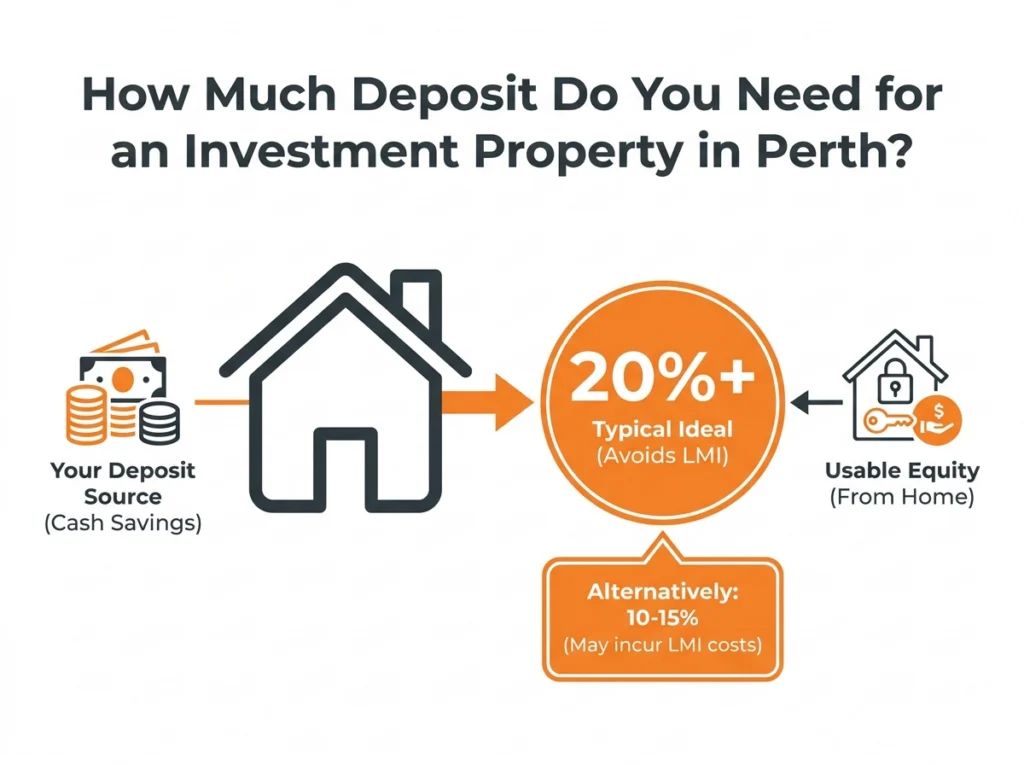
Here’s the short version: most lenders want a 20% deposit for an investment property. Some will go lower, and there’s more than one way to fund it.
How Much Deposit Do You Need?
Most Australian lenders ask for a minimum 20% deposit on an investment property loan to avoid Lenders Mortgage Insurance (LMI). Some lenders will approve an investment loan with a deposit as low as 10%, but LMI applies. The premium is typically higher than it would be for an equivalent owner-occupier loan.
| Deposit level | LMI status | Notes |
| 20%+ of the purchase price | Not required | The standard most lenders use for investment loans |
| 10-19% of the purchase price | Applies | Premium typically higher than an equivalent owner-occupier loan |
| Equity from an existing property | Depends on the lender | Can supplement or fully replace a cash deposit |
Perth homeowners with equity in their existing property may also be able to use that equity as some or all of the deposit. This can reduce how much cash they need to save. Deposit requirements generally sit higher for investment properties than for owner-occupier purchases, because lenders apply stricter loan-to-value limits to investment lending. The deposit is only one part of the bill, too: buyers also need to budget for stamp duty, settlement fees and any building or pest inspection costs.
Want to know exactly where you stand? Book a free, no-obligation chat with Strategic Mortgages Perth and we’ll map out your deposit and borrowing position together.
Why Investment Properties Often Require a Higher Deposit
Lenders generally view investment loans as carrying more risk than an owner-occupier loan. Rental income can vary, tenants can move out, and the borrower isn’t living in the property. Because of that added risk, lenders commonly ask for a lower loan-to-value ratio (LVR).
LVR is simply the amount you’re borrowing expressed as a percentage of the property’s value. An 80% LVR means you’re borrowing 80% of the purchase price and putting down the other 20% as a deposit. The lower your LVR, the more competitive your rate and loan options are likely to be.
Using Equity Instead of Cash
Many Perth investors don’t fund their deposit from cash savings at all. If you already own a home, you may have built up equity: the gap between what your property is worth and what you still owe on it. Some lenders let you release part of that equity and use it as the deposit on your next purchase, which is worth checking before you start house-hunting.
Our guide on using equity to buy an investment property in Perth covers how usable equity is calculated and what the process looks like in practice.
Lenders Mortgage Insurance for Investment Properties
If your deposit is below 20%, most lenders will require Lenders Mortgage Insurance. LMI is a one-off premium that protects the lender, not you, if you default and the property doesn’t cover the outstanding loan.
LMI on an investment property typically costs more than LMI on an equivalent owner-occupier loan, because lenders and insurers price investment lending as higher risk. Premiums vary by lender and insurer, and are generally calculated on your LVR and loan amount. It’s worth getting the numbers run for your specific situation rather than relying on a rule of thumb.
For a fuller explanation of how LMI is calculated and ways to reduce or avoid it, see our guide to Lenders Mortgage Insurance in Perth. MoneySmart also has a plain-English explainer on how LMI works.
What a 20% Deposit Looks Like on a Perth Investment Property
Perth’s regional price bands give a clearer picture than a single citywide figure. According to REIWA, Perth’s median house sale price in the March 2026 quarter was $930,000 in Perth Outer, $1,250,000 in Perth Middle and $1,950,000 in Perth Inner. The figures come from the REIA Real Estate Market Facts report, published 30 June 2026.
- Perth Outer: median house price $930,000, so a 20% deposit is approximately $186,000
- Perth Middle: median house price $1,250,000, so a 20% deposit is approximately $250,000
- Perth Inner: median house price $1,950,000, so a 20% deposit is approximately $390,000
Units and townhouses are typically a more affordable entry point. REIWA’s March 2026 quarter data put the median for other dwellings (units and townhouses) in Perth Outer at $642,500, meaning a 20% deposit of approximately $128,500.
These figures are indicative only and move with the market. Your own borrowing capacity and required deposit depend on your income, existing debts, the lender’s policy and the property itself. Treat them as a starting point for a conversation, not a fixed number.
Other Costs Beyond the Deposit
The deposit is usually the biggest number, but it isn’t the only cost of buying an investment property in Perth. Buyers also need to budget for:
- Stamp duty
- Loan establishment fees
- Building and pest inspections
- Settlement costs
Settlement costs in Western Australia are a separate expense from your deposit and loan. Strategic Settlements has a detailed breakdown of settlement agent fees in WA, a useful reference when budgeting for the full cost of a purchase.
Already have one investment property and thinking about a second or third? Our guide on how Perth investors build a property portfolio looks at the bigger picture beyond a single deposit.
Ready to Map Out Your Deposit?
Every lender assesses deposit and LVR requirements a little differently, and your own equity position can change the picture entirely. Strategic Mortgages Perth can map out your options and show you what’s realistic for your situation.
Book a free, no-obligation chat with Strategic Mortgages Perth
Frequently Asked Questions
What is the minimum deposit for an investment property in Australia?
Most lenders across Australia look for a 20% deposit on an investment property to avoid Lenders Mortgage Insurance. Some lenders will accept a deposit as low as 10%, but LMI will generally apply and the exact minimum depends on the lender and your circumstances.
Can I use equity instead of a cash deposit for an investment property?
Yes, in many cases. If you have equity in an existing property, you may be able to use some or all of it as the deposit for an investment purchase. This can reduce the cash you need to save. How much you can access depends on your current loan, the property’s value and the lender’s policy.
Do investment properties always need a bigger deposit than a home you live in?
Not always, but it’s common. Lenders generally view investment lending as higher risk than owner-occupier lending, so deposit and LVR requirements are often stricter. This varies by lender, so it’s worth comparing your options.
Does the deposit cover all the upfront costs of buying an investment property?
No. The deposit is one part of the total cost. Stamp duty, loan fees, building and pest inspections, and settlement costs are separate expenses that also need to be budgeted for.
Disclaimer: The information provided in this article is general in nature and does not constitute financial, tax, or legal advice. Individual circumstances vary. Deposit requirements, LVR thresholds and LMI premiums are set by individual lenders and insurers and are subject to change. Perth median price data is sourced from REIWA/REIA and reflects the March 2026 quarter; property markets move, so confirm current figures before making a decision. We recommend consulting with qualified professionals before making financial decisions.