An investment loan is assessed differently from a loan on the home you live in. Lenders test the repayments at a higher rate than you pay and count only part of the rent. They also look at every debt you already hold, and the way your loans are secured can affect your next purchase.
We take a methodical approach and know lender policies well, including the policies that apply when you already own several properties.
Testing the Repayments at a Higher Rate
Banks and other lenders regulated by APRA must check that you could still meet the repayments if rates rose. APRA’s minimum buffer is 3 percentage points above the loan’s interest rate, a setting it kept in May 2026, so a loan at 6.5% is tested at 9.5% or higher. The buffer applies to your existing loans as well as the new one, so your current home loan is tested at the higher rate too. These lenders also use your declared living expenses or a benchmark figure, whichever is higher.
Since 1 February 2026, APRA has also capped lending where a borrower’s total debts are six or more times their income. Each bank can make no more than 20% of its new investor loans at that level, so a single loan above it is still possible.
How Much of the Rent Counts
Lenders don’t count all the rent. APRA’s guidance to the banks it regulates is to discount expected rent by at least 20%, and by more where a property has a higher risk of sitting vacant. So a bank counts no more than 80% of the rent. Lenders also allow for costs such as strata fees, either by taking them off the rent or by adding them to your expenses. Policies differ from lender to lender.
What the Test Looks Like on a $560,000 Loan
Illustrative example only. The figures are approximate. They are not a quote or a loan offer, and individual outcomes vary.
Assumptions: a unit bought for $700,000 and rented at $700 a week, close to REIWA’s current Perth medians for units. A $560,000 loan (80% of the price, so no LMI) at a variable rate of 6.5% a year that stays the same, with principal and interest repayments over 30 years. The lender tests at 9.5% and counts 80% of the rent. Purchase costs, property expenses, tax and your other debts are left out.
- At 6.5%, the repayment is about $3,540 a month against rent of about $3,030, a shortfall of about $510 before property costs.
- At the lender’s 9.5% test rate, the repayment is about $4,710 a month against counted rent of about $2,430, a shortfall of about $2,280.
In the lender’s test, the rest of your income has to cover the larger shortfall, after tax, living expenses and your other debts. A lender that counts less of the rent would show a bigger gap.
Deposits and Lenders Mortgage Insurance
Your loan-to-value ratio (LVR) is the loan as a share of the property’s value. If it’s above 80%, you may need to pay lenders mortgage insurance (LMI), a one-off cost that protects the lender, not you. The value a lender uses is its own valuation, which can come in below the price you’ve agreed to pay. Our guides cover how LVR works and how much deposit an investment property needs.
Using Equity in Your Home
You can use equity in your home in place of a cash deposit. Usable equity is usually up to 80% of the lender’s valuation of your home, less what you still owe on it, and borrowing beyond that may mean paying LMI. Equity on its own doesn’t get a loan approved. The total borrowing still has to pass the repayment test. Our guide to accessing the equity in your home explains the options.
Interest-Only or Principal and Interest
With interest-only repayments, you pay only the interest for a set period, for example five years, and the balance doesn’t fall. Repayments rise when the period ends, because the balance is then repaid over a shorter term. ASIC’s Moneysmart website notes that interest-only rates can be higher than principal and interest rates, and that you pay more over the life of the loan. APRA expects banks to assess an interest-only loan on the principal and interest repayments that apply after the interest-only period, over that shorter term, which can reduce how much you can borrow. Our guide to interest-only investment loans goes into more detail.
Five Years Interest-Only, Then Principal and Interest
Illustrative example only. The figures are approximate, not a quote or a forecast, and individual outcomes vary.
Assumptions: the same $560,000 loan over 30 years at 6.5% a year for the whole term, the same rate for both options, no extra repayments, no offset balance and no fees.
- Principal and interest from the start: about $3,540 a month for 30 years, and about $714,000 in total interest.
- Five years interest-only, then principal and interest: about $3,030 a month, then about $3,780 a month for the last 25 years, and about $756,000 in total interest. That is about $42,000 more.
At a 9.5% test rate, a lender would assess the interest-only loan at about $4,890 a month, against about $4,710 for the 30-year principal and interest loan.
Offset Accounts and Redraw
An offset account is a separate account linked to the loan. Its balance reduces the amount of the loan that’s charged interest, and you can still use the money. A redraw facility holds extra repayments inside the loan, and you may be able to take them out again, depending on the loan’s terms. Some lenders charge for an offset through a higher rate or account fees, so compare that cost with the interest you expect to save. If a loan is, or may become, an investment loan, ask a qualified tax professional how offset and redraw could affect the tax treatment of the interest. Our guide compares offset accounts and redraw facilities.
Standalone or Cross-Collateralised Loans
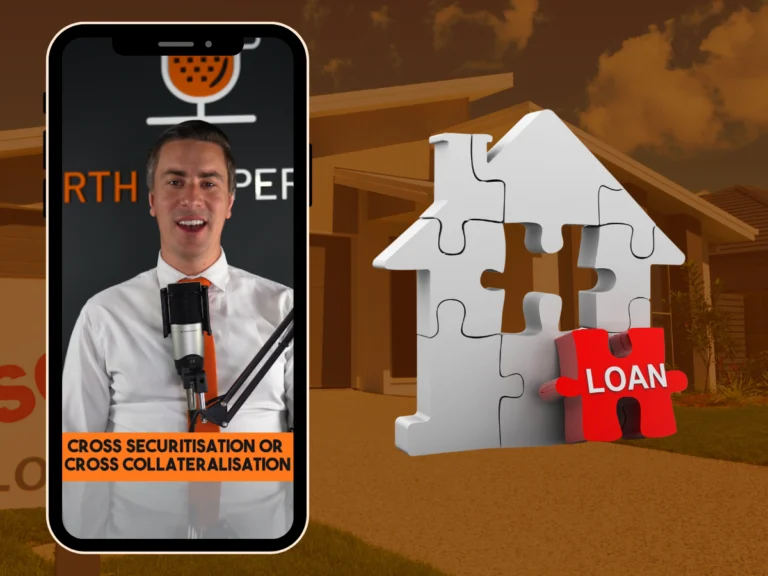
A standalone loan is secured by one property. A cross-collateralised loan uses more than one property as security, often your home and the investment property together. It can be simpler to set up with one lender, but that lender then holds more than one of your properties, so selling one or moving a loan to another lender can involve the others. Standalone loans keep each property separate, usually with a separate loan against your home for the deposit. Our guide explains cross-collateralisation and standalone loans. If your loans are already tied together, refinancing may be one way to separate them.
Perth Rental and Lending Figures, October 2026
- Rents: REIWA’s latest Perth figures, as at October 2026, put the median weekly rent at $750 for houses and $700 for units.
- Vacancy: REIWA recorded a Perth vacancy rate of 1.7% in September 2026, down from 2.2% in July. REIWA treats 2.5% to 3.5% as a balanced market.
- Yields: Cotality put Perth’s gross rental yield at 4.0% for dwellings at the end of September 2026, with houses at 3.9% and units at 5.2%.
- Values: Cotality recorded a 4.7% fall in Perth dwelling values over the September quarter, leaving them 10.1% higher than a year earlier. A lower valuation means less usable equity.
- Investor lending: the ABS counted about 6,350 new investor loans in Western Australia in the June quarter 2026 (seasonally adjusted). The average new investor loan in the state was about $678,000, up from about $582,000 a year earlier.
Gross yield is a year’s rent as a share of the property’s value, before interest, strata, council rates, insurance, management fees and vacant weeks. These figures are updated regularly.
Tax and SMSF Questions
We arrange loans. We don’t give tax or financial product advice, and we can’t advise on self-managed super funds (SMSFs). Questions about negative gearing, depreciation or the tax treatment of interest are for a qualified tax professional. Whether to invest through an SMSF, or how a property fits your wider investments, is a decision to make with a licensed financial adviser.
For Investors
Our guides go into more detail on the questions investors ask us most:
- Interest-only investment loans and what happens when the interest-only period ends
- How much deposit an investment property needs in Perth
- Using equity in your home to buy an investment property
- Cross-collateralised and standalone loans when you own more than one property
- How Perth investors finance a second and third property
- The Perth property market in 2026 from an investor’s point of view
To talk through a purchase, book a time with a broker online or send us a question.
Disclaimer: The information provided in this article is general in nature and does not constitute financial, tax, or legal advice. Individual circumstances vary. We recommend consulting with qualified professionals before making financial decisions.