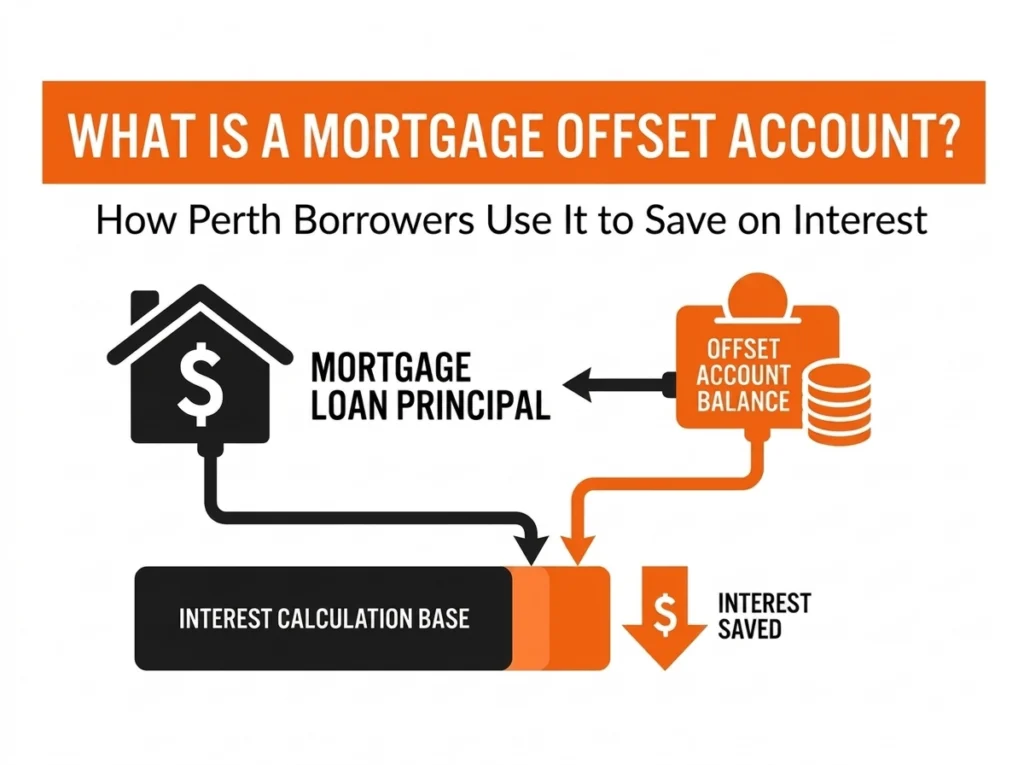
Many Perth homeowners have an offset account attached to their home loan and never fully use it. Others are comparing loan products and wondering whether the offset feature is worth paying for. Either way, the question is the same: what exactly does a mortgage offset account do, and how does an offset account work in practice?
A mortgage offset account is a transaction account linked directly to a home loan, where the account balance reduces the amount you owe on your loan for the purpose of calculating interest. On a $500,000 home loan with $50,000 held in an offset account, interest is calculated on $450,000, not the full loan balance. Most major Australian lenders offer offset accounts on variable-rate home loans; availability on fixed-rate loans is limited and varies by lender. Consistently holding funds in an offset account may reduce both the monthly interest charged and the effective loan term over time. Perth borrowers who regularly keep larger amounts in their offset account tend to see the greatest benefit, as more money held means less interest charged each day.
What Is a Mortgage Offset Account?
An offset account is a deposit account (typically a standard transaction account) held with the same lender as your home loan. Your account balance offsets your loan balance each day for the purpose of calculating interest.
Simply put: interest is charged only on the difference between your remaining loan balance and the balance sitting in your offset account. Not on your full loan amount.
It’s your money. You can spend it, deposit salary into it, use it for everyday transactions. The offset benefit applies for every day the balance is held. There’s no lock-in period or minimum holding time.
How Does a Mortgage Offset Account Work?
Home loan interest is typically calculated daily and charged monthly. With an offset account, the lender calculates daily interest on the net figure: your loan balance minus your offset balance.
Here’s a simple worked example. This example is for illustration purposes only. Actual outcomes depend on your loan amount, interest rate, and average offset balance over time.
Imagine two Perth borrowers with identical $600,000 home loans at the same variable rate:
- Borrower A has no offset account. Interest is calculated on $600,000 every day.
- Borrower B consistently keeps $50,000 in a linked offset account. Interest is calculated on $550,000 every day.
Over months and years, that daily reduction can add up to real savings on total interest paid, and a shorter loan term overall. The actual impact depends on how consistently funds are held and what the interest rate does over time.
How Much Could You Save? The Numbers in Context
*All figures are for illustration purposes only. Individual outcomes will vary based on your loan balance, interest rate, and actual average offset balance.*
| Loan Balance | Offset Balance | Interest Calculated On |
| $600,000 | $0 | $600,000 |
| $600,000 | $30,000 | $570,000 |
| $600,000 | $60,000 | $540,000 |
| $600,000 | $100,000 | $500,000 |
The more you hold in the account on average, the greater the benefit. Perth borrowers with significant savings, regular salary deposits, or rental income flowing through their offset account tend to see the biggest difference.
Who Benefits Most From an Offset Account?
Offset accounts tend to work best for borrowers who:
Hold regular, consistent income in the account. If your salary is deposited directly into your offset account and stays there until bills go out, the average daily balance stays high, and the interest reduction is maximised across the full pay cycle.
Have strong cash flow. The larger and more consistent the balance, the greater the impact. If your account often runs close to zero between pay days, the benefit will be smaller, though still positive on days when a balance is held.
Are property investors who want to protect their interest deductions. For investment loans, the interest you pay may be tax-deductible. If you make extra repayments directly into the loan, you reduce the loan balance and potentially reduce the amount of deductible interest. Keeping cash in an offset account instead keeps the loan balance (and the deductible interest) intact, while still reducing what you’re charged each day. Speak with a qualified accountant about how this applies to your specific situation. This article does not constitute tax advice.
Keep a meaningful balance relative to their loan. The daily interest saving from an offset account is calculated as: your interest rate applied to whatever amount you hold in the account. A $50,000 offset saves the same dollar amount per day regardless of your total loan size. Keeping $100,000 in the account saves twice as much per day as keeping $50,000. The bigger your offset balance, the greater the daily saving.
Variable vs Fixed Rate Offset Accounts
Most offset accounts in Australia are available on variable-rate home loans. If your loan is variable, check with your lender whether an offset account is included in your product. Some variable loans include it as standard; others charge a higher rate or an annual package fee for the feature.
On fixed-rate home loans, offset availability is more limited. Some lenders offer a partial offset account on fixed-rate products, meaning only a portion of your savings can be used to offset the loan rather than your full balance. Full offset functionality on a fixed rate is not standard across the market and typically comes with restrictions. If you’re considering fixing your rate, confirm directly with your lender or broker whether an offset account is available on that product and exactly how it functions during the fixed term.
How Does an Offset Account Compare to a Redraw Facility?
Both features can reduce the interest you pay, but they work differently. Here’s how.
An offset account holds your money in a separate linked transaction account. Your funds sit alongside the loan and reduce the interest base. You retain easy access; it functions like a normal bank account.
A redraw facility holds extra repayments inside the loan itself. When you pay more than the minimum, that extra amount reduces the loan balance and can typically be withdrawn later. Access varies by lender: some require minimum redraw amounts, charge fees, or take time to process withdrawals.
For most owner-occupiers (people who live in the home they’ve borrowed against), the practical difference comes down to accessibility and day-to-day flexibility. For property investors, the tax implications of each structure can be significant. That’s a question for your accountant, not your broker.
For a full comparison of both features, see our guide on offset account vs redraw facility
For the other choices on an investment loan, such as interest-only repayments and how the loans are secured, see our page on investment loans in Perth.
Is an Offset Account Worth the Cost?
Some loan products charge a premium for an offset account: a higher interest rate, an annual package fee, or both. Whether that cost is worthwhile depends on a few things:
- Your likely average offset balance. A higher consistent balance makes it more likely the offset benefit outweighs the added cost.
- The rate and fee difference between a loan with an offset and a comparable loan without one.
- How you manage money day-to-day. If the account regularly runs close to zero, the benefit is reduced.
A mortgage broker can run the numbers for your specific situation across the lenders they work with before you commit to a product.
If you’re comparing home loan options or thinking about refinancing to a product with offset features, understanding your Perth home loan borrowing capacity is a useful starting point. ASIC’s MoneySmart home loan guide also provides an independent overview of home loan features if you want a second reference point.
Want to talk it through? The team at Strategic Mortgages Perth can review your current loan structure and compare offset products across lenders. Book a free consultation.
Frequently Asked Questions
What is a mortgage offset account in simple terms?
A mortgage offset account is a transaction account linked to your home loan. The balance in the account reduces the portion of your loan on which interest is calculated each day. The more you hold in the account, the less interest you may be charged. Your money remains accessible at all times; it functions like a standard bank account.
Can I use my offset account for everyday spending?
Yes. An offset account typically functions like a standard transaction account. You can deposit your salary, pay bills, and spend from it as normal. The offset benefit applies to whatever balance is held in the account each day, so keeping more in the account for longer may increase the interest reduction over time.
Do all home loans come with an offset account?
No. Offset accounts are not available on every home loan product. They’re most commonly included on variable-rate loans, and availability varies by lender and product tier. Some lenders include an offset account as standard; others offer it at a higher rate or with an annual fee. Always compare like-for-like when assessing loan products. A lower-rate loan without an offset may or may not be better value depending on the balance you’d maintain.
What is the difference between an offset account and a redraw facility?
An offset account holds your money in a separate account alongside the loan. A redraw facility holds extra repayments inside the loan itself. Both reduce the interest charged, but they differ in accessibility, flexibility, and potential tax implications (particularly for investors). See our comparison guide on offset account vs redraw facility for a full breakdown.
Is there a fee for having an offset account?
It depends on the lender and product. Some home loans include an offset account at no additional cost; others charge a higher rate or an annual package fee. Whether the offset is worth the added cost depends on the average balance you’re likely to maintain. A broker can compare the net benefit across products for your situation.
Can I have multiple offset accounts linked to my home loan?
Some lenders allow more than one offset account linked to the same loan. This can be useful for budgeting. For example, you could keep separate accounts for daily spending, bills, and a savings buffer while still benefiting from the full combined offset balance. Availability varies by lender and product.
Want to Know If an Offset Account Is Right for Your Perth Home Loan?
Talk to the team at Strategic Mortgages Perth. We can look at your current loan structure, work out the potential benefit for your situation, and compare offset products across the lenders we work with.
Book a free loan review or explore your options around refinancing your Perth home loan if you’re considering switching to a product with offset features.
*Disclaimer: The information provided in this article is general in nature and does not constitute financial, tax, or legal advice. Individual circumstances vary. We recommend consulting with qualified professionals before making financial decisions. The examples used in this article are illustrative only. Actual outcomes will depend on your specific loan terms, interest rates, and financial situation.*