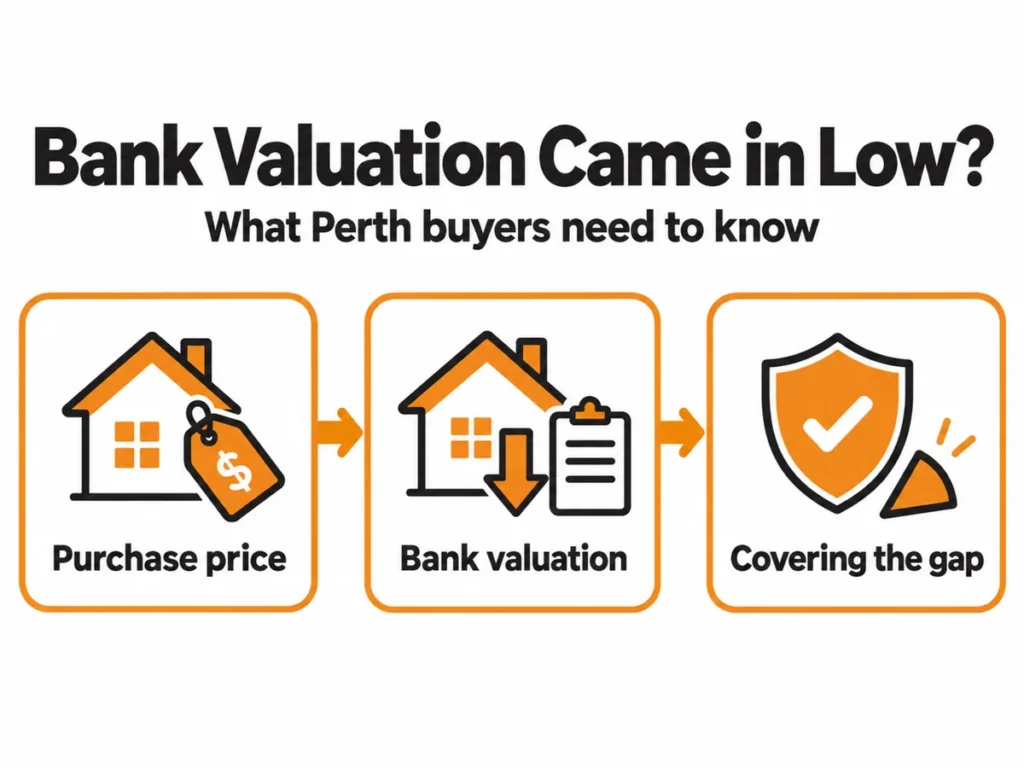
You have had your offer accepted, finance is progressing, and then your broker or lender calls: the bank’s valuation has come in below the price you agreed to pay. In a market that has moved as quickly as Perth’s has since 2024, this happens more often than most buyers expect, and it is not a judgement on your purchase. This guide explains why bank valuations come in low, what a shortfall does to your loan, and the options that buyers and their brokers typically work through when it happens.
In short: a bank valuation is an independent estimate of what the property would sell for, prepared for the lender to size its risk, and it is often more conservative than the price agreed between a motivated buyer and seller. When it comes in below the purchase price, the lender bases the loan on the lower figure, not on what you are paying. That pushes up your loan-to-value ratio (LVR), and if it crosses 80% it can trigger lenders mortgage insurance or reduce the amount the lender will advance. The options that exist include contributing extra funds, asking the lender to review the valuation with comparable sales, having a different lender order its own valuation, renegotiating with the seller, or relying on the finance clause in a Western Australian contract. Which of these applies depends on your contract dates and your deposit position.
What a Bank Valuation Is and How It Differs From an Appraisal
A real estate agent’s appraisal is a marketing estimate. A bank valuation is a formal assessment prepared by a licensed valuer, instructed by the lender, to confirm the property is adequate security for the loan. The valuer is working for the bank and answering a narrower question: if this borrower defaulted, what would this property realistically sell for?
Lenders use three main types of valuation:
- Automated or desktop valuation: a model using recent sales data and property attributes, with no inspection. Common for lower-LVR loans in established suburbs with plenty of comparable sales.
- Kerbside valuation: the valuer views the property from the street and combines that with sales data.
- Full valuation: the valuer inspects inside and out. Usual for higher LVRs, unusual properties, rural or semi-rural blocks and higher-value homes.
Which type the lender orders is its decision, and different lenders have different policies on when each applies.
Why Bank Valuations Come in Below the Purchase Price
A shortfall usually comes back to one of the following:
- The market is moving faster than the sales data. Valuers rely on settled comparable sales, which lag the market by weeks or months. When prices are rising quickly, as they did across much of Perth through 2024 and 2025, today’s agreed price can sit above what last quarter’s sales support. REIWA’s Perth median house price reached approximately $938,000 in the June 2026 quarter, up 4.2% for the quarter, and valuers were still working from sales struck at lower levels.
- Competitive buying. A property that sold at a home open with several offers, or above the advertised range, may have fetched a price that the comparable sales do not yet reflect.
- Few comparable sales. Unusual homes, large blocks, properties in small suburbs or in outer areas like parts of the Perth Hills or the Peel region give the valuer less to work with, and valuers tend to be conservative when evidence is thin.
- Off-the-plan and new builds. The valuation is done on completion, sometimes 12 to 24 months after the contract was signed, so the two figures were never going to be measured at the same point in the market.
- Condition and unapproved works. A valuer may discount for deferred maintenance, or exclude value attributed to structures that do not appear on council records.
What a Low Valuation Does to Your Loan
The lender lends against the lower of the purchase price and the valuation. So if you agree to pay $800,000 and the valuation comes in at $760,000, the lender treats the property as worth $760,000 for the purposes of the loan. Your loan-to-value ratio is then calculated on $760,000, and two things can follow:
- If your LVR moves above 80%, the lender may require lenders mortgage insurance, a one-off premium that can run into the thousands and is paid by you to protect the lender.
- If your LVR moves above the lender’s maximum for that loan type, the lender may reduce the amount it will advance, and you need to find the difference from your own funds.
Your pre-approval was always conditional on a satisfactory valuation, which is why this stage exists.
A Worked Example
This example is hypothetical and illustrative only. It uses round figures. Actual outcomes depend on your lender’s policy, the valuation and your own deposit.
A Perth couple agree to buy a house in Bayswater for $800,000 with a $160,000 deposit, planning to borrow $640,000 at an LVR of 80% and avoid LMI. The bank valuation comes in at $760,000.
- Loan of $640,000 against a $760,000 valuation is an LVR of approximately 84.2%.
- To stay at 80% LVR, the maximum loan becomes $608,000.
- The couple would need to find approximately $32,000 more in cash, or accept an LVR above 80% and pay an LMI premium, if the lender’s policy allows the higher LVR at all.
The purchase price has not changed. What has changed is the lender’s view of the security, and that reshapes the whole funding position.
The Options Buyers Typically Work Through
None of these is right for everyone. They are the paths that exist, and a broker’s job is to set out which are realistically open in your case.
1. Contribute the difference. If savings or a family gift can cover the gap, the loan proceeds as planned at the lower valuation. Any gift needs to be documented in the way the lender requires.
2. Ask the lender to review the valuation. Valuers will reconsider if presented with recent comparable sales they may have missed, ideally settled sales of similar properties in the same suburb within the last three to six months. Your buyer’s agent, selling agent or broker can help compile these. Reviews do not always change the result, but they are free to request.
3. Try a different lender. Each lender instructs its own valuer, and valuations for the same property can differ. A broker can sometimes order an upfront valuation with another lender before a full application is lodged, which avoids a second credit enquiry until the numbers are known. There is no guarantee the second figure will be higher.
4. Renegotiate the price. Sellers are not obliged to move, but a valuation shortfall is objective evidence that other buyers’ lenders may reach a similar view. In a market with more listings and longer selling times, as Perth has seen through 2026, some sellers will negotiate rather than start again.
5. Rely on the finance clause. Most Western Australian offer and acceptance contracts are subject to finance approval by a stated date. If the shortfall means you cannot obtain finance on the terms in the contract, and you act within the clause’s timeframe and requirements, you may be able to withdraw. This is a legal matter, and how the clause is worded and how notices are given matters a great deal. Speak to your settlement agent or solicitor immediately, and see Strategic Settlements’ guide on what to do if settlement is delayed in Perth for how timing issues play out on the conveyancing side.
Reducing the Risk Before You Make an Offer
A low valuation cannot be ruled out, but Perth buyers can reduce the odds of an unpleasant surprise:
- Look at settled sales, not just asking prices, for comparable homes in the suburb over the last six months. If your intended offer sits well above them, factor that in.
- Keep a buffer above your minimum deposit rather than committing every dollar, so a shortfall of a few per cent does not derail the purchase.
- Ask your broker whether an upfront valuation is available with the lender you are likely to use. Some lenders allow this before an application is lodged.
- Make sure the finance clause date in your offer allows enough time for the valuation to be completed and, if needed, reviewed.
Frequently Asked Questions
Why is the bank valuation lower than the purchase price?
Valuers work from settled comparable sales, which lag a rising market, and they answer a more conservative question than a buyer does: what the property would fetch if the lender had to sell it. Competitive bidding, thin sales evidence and off-the-plan timing gaps are the most common reasons for a shortfall.
Does a low valuation mean I paid too much?
Not necessarily. A valuation is one professional’s evidence-based estimate at a point in time, prepared for the lender’s purposes. It does not mean the market will not support the price, but it does mean the lender will only lend against the lower figure.
Can I challenge a bank valuation?
You can ask the lender to have the valuer review it, and supplying recent comparable sales gives the review something to work with. Valuers are not obliged to change the figure, and many reviews confirm the original result.
Will a second lender’s valuation be higher?
Sometimes, because each lender instructs its own valuer and may order a different type of valuation. There is no guarantee, and a broker can often check what an upfront valuation with another lender would show before a second application is lodged.
What happens if I cannot cover the shortfall?
The options are to accept a higher LVR with LMI if the lender allows it, renegotiate the price, or, where the contract’s finance clause permits and the timeframe has not passed, withdraw from the purchase. The finance clause is a legal question, so speak to your settlement agent or solicitor straight away.
Had a Valuation Come in Short?
If you are dealing with a valuation shortfall now, or want to understand your exposure before you make an offer, our brokers can set out which options are realistically open to you and check what an upfront valuation with another lender would show. Learn how our Perth mortgage brokers work or book a free, no-obligation chat with Strategic Mortgages Perth.
Disclaimer: The information provided in this article is general in nature and does not constitute financial, tax, or legal advice. Individual circumstances vary. The examples used in this article are illustrative only, and actual outcomes will depend on your lender’s policy, the valuation and your financial situation. Market figures are sourced from REIWA and are current as at the June 2026 quarter. We recommend consulting with qualified professionals before making financial decisions.