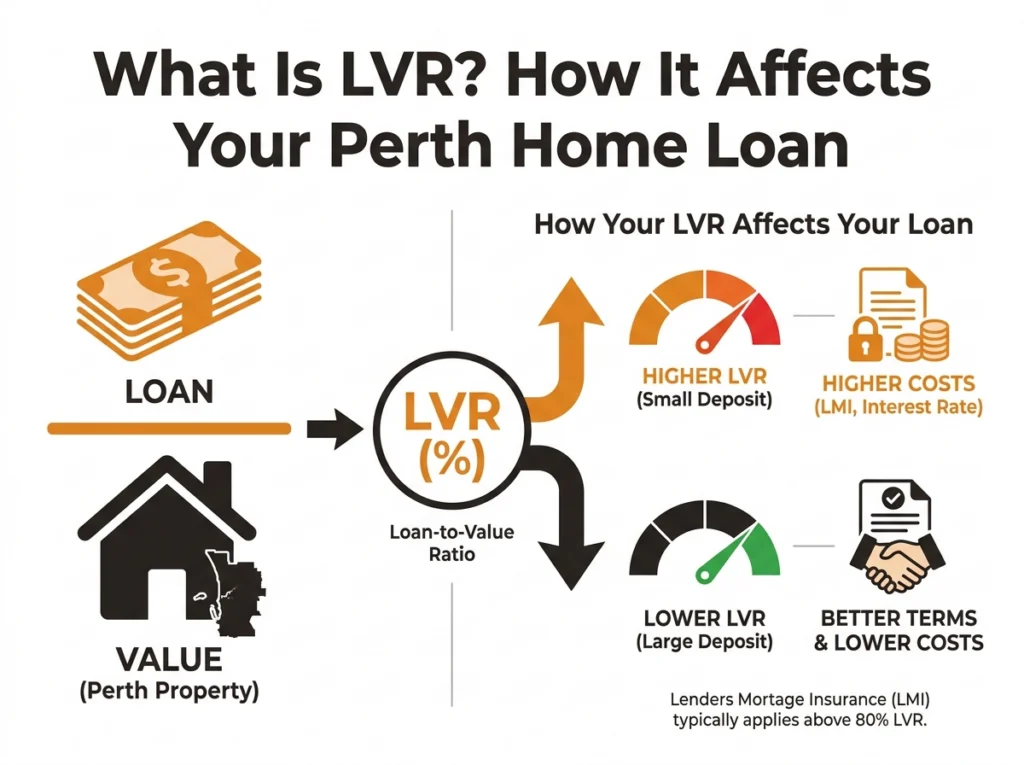
If you’ve started looking into home loans in Perth, you’ve probably seen the term LVR on a lender’s website or heard a broker mention it, and wondered what LVR actually is. It’s one of the most important numbers in your home loan application. It affects whether you’ll pay Lenders Mortgage Insurance and the interest rate you’re offered.
This guide explains what LVR stands for, how to calculate it, and what different LVR levels commonly mean for your borrowing options in Perth.
What Is LVR (Loan-to-Value Ratio)?
LVR stands for Loan-to-Value Ratio, sometimes written as your LVR ratio. It’s the amount you’re borrowing, expressed as a percentage of the lender’s assessed value of the property, not necessarily the purchase price or your own estimate.
LVR = (loan amount ÷ property value) × 100
A $400,000 loan on a $500,000 property is an 80% LVR. When a borrower’s LVR is above 80%, most lenders require Lenders Mortgage Insurance (LMI), a one-off premium that protects the lender, not the borrower, if the loan isn’t repaid. A lower LVR generally gives borrowers access to more competitive interest rates and a wider range of loan products.
LVR isn’t fixed at settlement. It changes over time as your repayments reduce the loan balance, and as property values shift. That’s why many Perth homeowners have a lower LVR today than when they first took out their loan.
How to Calculate Your LVR
You can work out your current LVR at any time by dividing your remaining loan balance by the property’s current value, then expressing the result as a percentage.
Say a Perth homeowner has a home loan balance of $520,000 remaining, and their property is currently valued at $650,000. Their LVR is:
$520,000 ÷ $650,000 = 0.80, or an 80% LVR
This example is illustrative only, using round numbers to show the calculation. Your own LVR depends on your actual loan balance and an up-to-date valuation of your property.
One thing worth knowing: the “property value” in this formula is commonly the lender’s own bank valuation, not a real estate agent’s appraisal or your own estimate. Bank valuations can come in lower than market expectations, so it’s worth asking your broker how a lender is likely to value your property first.
What LVR Thresholds Mean for You
Every LVR home loan sits in one of a few common bands. Exact thresholds are set by individual lenders and vary across the market, but the following bands are commonly used as a general guide:
| LVR band | LMI | What it commonly means |
| Under 80% | Typically not required | Access to a wider range of lenders and loan products |
| 80–90% | Typically required | Still commonly approved, subject to the lender’s own assessment |
| Above 90% | Typically required, and fewer lenders offer this band | Options are more limited and often depend on your individual circumstances |
These bands are a general guide only. Exact thresholds, and whether a loan is approved at all, depend on the individual lender’s policy and a full assessment of your circumstances. No LVR level guarantees approval.
If you’re a first home buyer sitting in the 90%+ band, it’s worth knowing about the Australian Government’s 5% Deposit Scheme (formerly known as the First Home Guarantee). Eligible buyers may be able to access a loan at that LVR without paying LMI at all. Our guide to the 5% Deposit Scheme for Perth first home buyers covers eligibility and how it works.
How LVR Affects Your Interest Rate
Lenders commonly price loans in tiers based on LVR, because a lower LVR represents less risk to the lender. In practice, this typically means borrowers with a lower LVR can access more competitive rate tiers and a broader choice of lenders.
Rate tiers, and the exact cut-off points a lender uses, vary and change with market conditions. Rather than quoting a specific rate here, it’s worth having a broker compare current offers across the market for your specific LVR.
LVR and Lenders Mortgage Insurance
When your LVR is above 80%, most lenders require LMI. LMI is a one-off, typically upfront premium. It protects the lender if you default on the loan and the sale of the property doesn’t cover the outstanding balance. It’s important to understand that LMI protects the lender, not you as the borrower, even though the borrower commonly pays the premium.
LMI costs vary depending on your loan amount, your LVR and the insurer, and can add a meaningful amount to your upfront costs. For a fuller explanation of how LMI is calculated and ways it might be reduced, see our guide to Lenders Mortgage Insurance in Perth.
How Perth Property Growth Has Changed Your LVR
LVR moves with property values as well as your loan balance, and Perth’s market has moved considerably. REIWA puts the median Perth Metro house price at $938,000 for the 12 months to June 2026. That’s up from around $490,000 in January 2021, an increase of roughly 90% over that period.
For homeowners who bought several years ago, that kind of growth is significant. Many now hold considerably more equity, and a lower LVR, than they did at settlement, even without making extra repayments. A current valuation can reveal how Perth property growth has built equity you may not realise you have. That can open up options like refinancing to a better rate tier, or using equity to buy an investment property in Perth.
How to Improve Your LVR
If your LVR is sitting higher than you’d like, there are a few common ways to bring it down over time:
- Make extra repayments. Reducing your loan balance faster directly lowers your LVR, subject to your loan’s terms and any limits on extra repayments.
- Let property growth work in your favour. If your property’s value has risen since you bought it, your LVR may already be lower than you think, worth confirming with an updated valuation.
- Refinance once your LVR has improved. A lower LVR can open the door to more competitive refinance options in Perth, subject to the lender’s assessment of your full application.
Want to Know Your Current LVR?
Want to know your current LVR and what it means for your borrowing options? Strategic Mortgages Perth can run the numbers and compare options across our lender panel.
Book a free, no-obligation chat with Strategic Mortgages Perth
Frequently Asked Questions
What is LVR on a home loan?
LVR stands for Loan-to-Value Ratio. It’s the amount you’re borrowing expressed as a percentage of the lender’s assessed value of the property, calculated by dividing your loan amount by the property value.
What is considered a good LVR?
There’s no single “good” LVR that applies to everyone, but an LVR of 80% or under commonly gives access to a wider range of lenders and typically avoids Lenders Mortgage Insurance. What’s achievable depends on your own deposit or equity position.
How do I calculate my LVR?
Divide your loan amount (or remaining loan balance) by the property’s current value, then multiply by 100. For example, a $520,000 loan balance on a $650,000 property is an 80% LVR.
Does my LVR change over time?
Yes. Your LVR typically falls as you pay down your loan balance and can also fall if your property’s value rises. It can also rise if property values fall, so it’s worth checking rather than assuming.
Can I reduce my LVR without selling my property?
In many cases, yes. Making extra repayments reduces your loan balance, and if your property’s value has grown, your LVR may already be lower than it was at settlement. A current valuation is the only way to know for sure.
Disclaimer: The information provided in this article is general in nature and does not constitute financial, tax, or legal advice. Individual circumstances vary. LVR thresholds, LMI requirements and interest rate tiers are set by individual lenders and are subject to change. We recommend consulting with qualified professionals before making financial decisions.