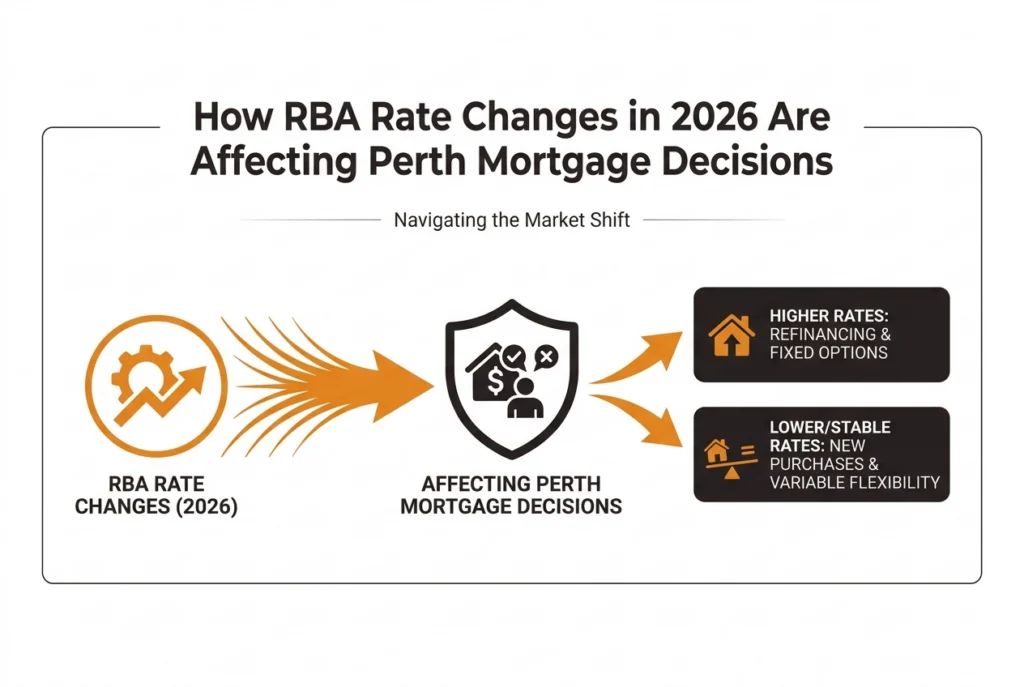
If you’ve watched the news about the Reserve Bank of Australia this year and wondered what it actually means for your own mortgage, you’re not the only one asking. Perth borrowers have had four cash rate increases to make sense of in 2026, the latest on 29 September. Here’s how that reaches your repayments, whether you’re on a variable or fixed rate, and when it’s worth reviewing your loan.
The Reserve Bank of Australia’s cash rate decisions directly influence variable home loan interest rates. When the RBA raises or lowers the cash rate, most lenders adjust their standard variable rates within days of the announcement. Lenders retain discretion over how much of any RBA rate movement they pass through to borrowers, so the full cash rate change is not always reflected in lending rates. Variable-rate borrowers see their monthly repayments change when rates move; borrowers on fixed-rate loans are unaffected until their fixed term expires. A rate change does not automatically make refinancing the right decision. Break costs on fixed-rate loans, current serviceability, and the gap between a borrower’s existing rate and available market rates all affect whether switching makes financial sense.
In plain terms: break costs are what a lender may charge you for ending a fixed-rate loan early, and serviceability is the lender’s assessment of whether your income comfortably covers the repayments.
How RBA Rate Decisions Flow Through to Perth Mortgages
The cash rate is the interest rate banks charge each other on overnight loans. As the RBA’s own explainer on monetary policy transmission describes it, the cash rate has a strong flow-on effect on other interest rates, including what banks pay on deposits and charge on loans, but that effect is indirect. The RBA doesn’t set mortgage rates directly. It moves the cash rate, and lenders then decide how much of that movement to pass on to their own standard variable rate (SVR), based on their funding costs and competitive position.
That’s why two borrowers on the same lender’s variable rate can still end up paying different amounts after a cash rate decision. It depends on your existing discount, how long you’ve been with that lender, and the specific product you’re on.
The same RBA explainer sets out the flow-on effect plainly: when rates fall, repayments on variable-rate mortgages fall too, freeing up cash for the household. The reverse applies when rates rise, usually from your next repayment date after the lender’s announcement.
What the 2026 Rate Cycle Means for Variable Rate Borrowers
2026 has been an active year for the cash rate. After cutting rates three times across 2025, the RBA reversed course:
| Meeting date | Change | Cash rate after |
|---|---|---|
| 4 February 2026 | +0.25% | 3.85% |
| 18 March 2026 | +0.25% | 4.10% |
| 6 May 2026 | +0.25% | 4.35% |
| 17 June 2026 | Held | 4.35% |
| 12 August 2026 | Held (unanimous) | 4.35% |
| 30 September 2026 | +0.25% (unanimous) | 4.60% |
That’s three increases in under four months, two holds, and then a fourth increase at the end of September that took the cash rate to 4.60%.
To put that in perspective, here’s an illustrative example only, on a $500,000 variable loan over a 30-year term:
| Rate | Monthly repayment | |
|---|---|---|
| Before the 2026 hikes | 6.00% | ~$2,998 |
| After the four 2026 increases | 7.00% | ~$3,327 |
| Difference | +1.00% | ~$329 a month |
This is a hypothetical example only. It assumes a starting rate that isn’t necessarily yours, a lender passing on the full 1.00% (not guaranteed, as covered above), and a standard 30-year principal and interest loan. Your own repayment change depends on your actual loan balance, rate, and how much of the increase your specific lender passed through, so treat this as a way to understand the scale of the impact, not a figure to expect on your own statement.
In its 29 September statement, the RBA said recent inflation had come in stronger than expected and that upside risks to inflation were materialising, including higher global energy prices. The decision was unanimous, and the Board said it could raise the cash rate further if that is needed to bring inflation back to target.
For Perth borrowers on a variable rate, repayments on most variable loans have moved higher across the year with the 2026 increases. Lenders usually announce within a few days whether they are passing on a rise, and the new rate generally applies from your next repayment date, so the September increase may only now be reaching some statements. If the RBA holds rates for a sustained period, or cuts them at a future meeting, variable repayments could stabilise or ease. Neither outcome is guaranteed, and the Board has said further increases remain possible. Perth and wider Western Australian borrowers are best placed comparing their current rate against what other lenders are offering right now, rather than trying to time a future rate move.
What It Means for Fixed Rate Borrowers
If you’re on a fixed rate, none of the 2026 cash rate moves have changed your repayments directly. That’s the point of fixing. Your rate stays as agreed until your fixed term ends.
What matters is what happens at expiry. Most lenders automatically roll a fixed-rate loan onto their standard variable rate once the fixed term is up, and that rate is rarely their most competitive offer. If your fixed term is ending in the next few months, it’s worth reviewing your options 60–90 days out, rather than defaulting to whatever rate you’re rolled onto. New fixed rates being offered today are priced on where lenders expect the cash rate to go over the fixed period, not necessarily where it sits today, so a new fixed rate may look different again from the one you locked in previously.
Should You Review Your Loan When Rates Change?
A rate decision, on its own, isn’t a reason to act. It’s a reason to check. The same logic holds whether the RBA is hiking, holding, or eventually cutting rates: your mortgage strategy should come from comparing your actual numbers, not from guessing what the RBA will do next.
A few situations are commonly worth a closer look:
- Your fixed rate term is ending within 60–90 days. Most lenders roll an expired fixed loan onto their standard variable rate automatically, and it’s rarely their sharpest offer.
- You haven’t compared your rate to the market in the past 12 months. Lenders update their pricing regularly, so a competitive rate from last year may not still be one.
- The gap between your rate and current offers looks meaningful on your loan balance. Even a small difference adds up over a 25 or 30-year term.
- Your income, property value, or life circumstances have changed. A loan structure that suited you at settlement may not suit you now, on top of whatever the rate environment is doing.
None of these on their own guarantees that switching or restructuring will leave you better off. That depends on a full assessment of your circumstances, current serviceability, and the lender’s own criteria at the time. Discharge fees, application fees, and, for fixed loans, break costs all need to be weighed against any saving. Switching matters less if you’re staying in the loan for years, and more if you expect to sell or refinance again soon.
ASIC’s MoneySmart mortgage switching calculator is a reasonable starting point for a rough, independent estimate before speaking with a broker. Our guide on refinancing a Perth home loan covers the process in more detail if a review points you toward switching, and our guide to refinance trigger points for Perth and Western Australian homeowners covers the other triggers, such as income changes and life events, in more depth.
Frequently Asked Questions
What is the RBA cash rate right now?
As at 6 October 2026, the RBA cash rate target is 4.60%. The RBA raised it by 0.25 percentage points at its 29 September meeting, effective 30 September, after increases in February, March and May 2026 and holds in June and August. Rates can change at the next scheduled meeting on 3 November 2026, so always verify the current rate with your lender or broker before making decisions.
How quickly do RBA rate changes affect my mortgage repayments?
For variable-rate loans, lenders typically announce whether they’re passing on a cash rate change within a few days of the RBA’s decision, with the change usually applying to your account from your next repayment date. Fixed-rate loans are unaffected until the fixed term expires.
What’s a good mortgage strategy if the RBA cuts interest rates?
If the RBA were to cut the cash rate at a future meeting, lenders could, but aren’t obliged to, reduce their variable rates, which may lower repayments for variable-rate borrowers. Fixed-rate borrowers wouldn’t see a change until their fixed term ends. As of October 2026, the RBA has been raising the cash rate, most recently in September, so a cut is a scenario to plan for rather than something already happening. The safest strategy either way is the same one this article recommends throughout: compare your actual rate against the market rather than trying to time the RBA.
Should I fix my rate now, or stay variable?
That depends on your budget’s sensitivity to further rate movements, how much flexibility you need (extra repayments, offset access, the ability to refinance without break costs), and your own view on the current rate environment. Our guide to fixed vs variable rates in Perth walks through the trade-offs in more detail.
Does an RBA rate hold mean rates won’t move again this year?
No. A hold means the Board left the cash rate unchanged at that particular meeting. It isn’t a commitment about future decisions. The June and August 2026 holds are an example. In August the RBA said it would raise the cash rate further if upside risks to inflation materialised, and it did so at the next meeting, on 29 September. Its September statement again left room for further increases. A future cut isn’t ruled out, but as of October 2026 the RBA’s stated position is about the risk of further increases, not a signalled cut.
I don’t have a mortgage yet. Does the 2026 rate cycle affect how much I can borrow?
Yes, if you’re applying for a new loan rather than reviewing an existing one. Lenders assess how much you can borrow partly based on current interest rates, so a higher cash rate generally means a lower borrowing capacity than the same income would have supported a year or two ago. Our guides on how much you can borrow for your mortgage and getting pre-approval in Perth cover this in more detail.
Where This Leaves Perth Borrowers
The 2026 rate cycle has moved in a different direction than a lot of borrowers expected after 2025’s cuts. That’s the point. A loan structure that suited you last year isn’t guaranteed to suit you now.
Whether you’re on a variable rate that’s moved with the cash rate, or a fixed rate that’s about to expire, our team compares your situation across 30+ lenders, so you’re working from real numbers instead of guesswork.
Book a free, no-obligation chat with Strategic Mortgages Perth to see how your current mortgage stacks up.
Disclaimer: The information provided in this article is general in nature and does not constitute financial, tax, or legal advice. Individual circumstances vary. Cash rate figures are accurate as at 6 October 2026 and are subject to change. Verify current rates with your lender or broker before making financial decisions. We recommend consulting with qualified professionals before making financial decisions.