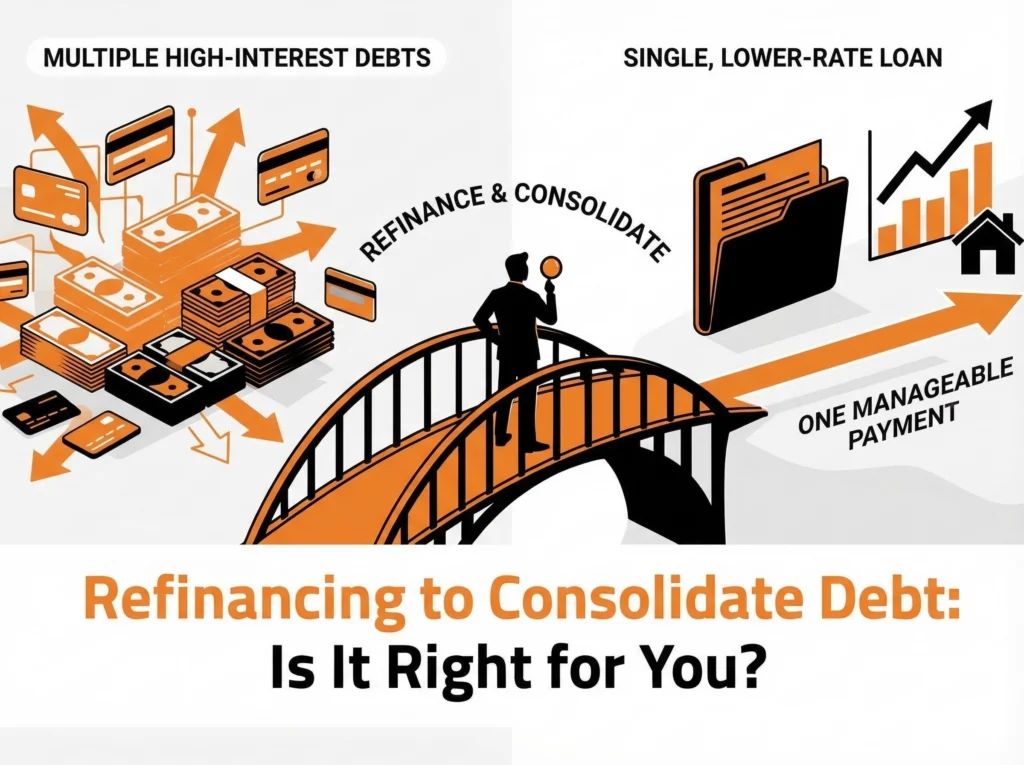
The idea of rolling everything into one manageable home loan payment can be incredibly appealing if you are currently juggling multiple debts, including personal loans, credit cards, and maybe a car repayment.
Debt consolidation through refinancing is one of the most common ways Australian homeowners explore, and for good reason. But like most financial decisions, it’s not a one-size-fits-all solution.
How Debt Consolidation Through Refinancing Works
When you consolidate debt using your mortgage, you’re essentially increasing your home loan balance to pay off other outstanding debts. Your lender (or a new lender) rolls those balances — credit cards, personal loans, buy-now-pay-later accounts — into your mortgage.
The result is a single monthly repayment, typically at a much lower interest rate than what you were paying across your various debts. Instead of tracking five different due dates with five different lenders, you have one payment, one lender, and one rate.
A mortgage broker can help you assess whether your current lender offers a competitive refinance option, or whether switching lenders altogether gives you better terms on a debt consolidation home loan.
The Appeal: Why So Many Homeowners Consider It
It’s easy to see why a consolidate debt mortgage strategy attracts attention. The numbers often look compelling on the surface:
Lower interest rate
Credit cards can carry interest rates of 18–22% or higher. Personal loans often sit between 8–15%. Home loan rates, by comparison, can be significantly lower, sometimes under 6% depending on the product, your financial profile, and prevailing market conditions.
Simplified finances
One payment replaces many. For people who feel overwhelmed managing multiple debts, this simplification alone can reduce financial stress.
Improved monthly cash flow
Rolling high-rate debts into a lower-rate mortgage often reduces your total monthly outgoings, freeing up cash each month.
For some borrowers, the ability to refinance and pay off debt in one move genuinely transforms their financial position. But the picture is more nuanced than the headline rate suggests.
The Risks You Need to Understand
Here’s where many borrowers are caught off guard: a lower interest rate doesn’t always mean you pay less overall.
When you consolidate short-term debt into a 25 or 30-year mortgage, you’re stretching that debt over decades. Even at a lower rate, the total interest paid over the life of the loan can be significantly more than if you’d paid off the original debts in their shorter timeframes.
There’s also the question of secured versus unsecured debt.
Credit cards and personal loans are unsecured, meaning if you can’t repay, lenders can’t automatically claim your home. Once you roll those debts into your mortgage, they become secured against your property. That’s a meaningful shift in risk.
Other considerations include:
- Discharge and refinancing fees from your current lender
- Lenders Mortgage Insurance (LMI) if your new loan pushes your LVR above 80%
- The temptation to re-accumulate. Consolidating debt doesn’t address spending habits, and some borrowers find themselves back in the same position within a few years
When Debt Consolidation Makes Sense
A debt consolidation home loan strategy may be genuinely beneficial when:
- You have sufficient equity in your home (ideally 20% or more remaining after consolidation)
- The debts you’re consolidating carry high interest rates and would take years to clear otherwise
- You have a stable income and can comfortably service the increased mortgage
- You have a realistic plan to avoid re-accumulating consumer debt after consolidation
- The monthly cash flow savings are meaningful and will go toward building your financial position
In these situations, working with an experienced mortgage broker can help you model the true cost of consolidation and compare it against alternative debt repayment strategies.
When to Avoid Debt Consolidation
Refinancing to pay off debt isn’t suitable for everyone. It’s worth reconsidering if:
- You have minimal equity in your home. Consolidating could push you into LMI territory or negative equity
- The debts are relatively small or short-term. It may be more cost-effective to clear them without touching your mortgage
- Your financial habits haven’t changed. Consolidating without addressing the root cause often leads to new debt accumulating on top of a now-larger mortgage
- You’re close to paying off your home. Extending your loan term to clear consumer debt can significantly delay your mortgage freedom date
- Your employment or income is unstable. Refinancing increases your secured debt in uncertain conditions
A good broker will tell you honestly when consolidation isn’t in your best interest, even if that means less business for them.
The Maths: A Simplified Example
To illustrate, say you have $20,000 in credit card debt at 19% interest, which you’re currently repaying at $500 per month. At that rate, it would take approximately 5.5 years to clear and cost around $12,000 in interest.
If you roll that $20,000 into a home loan at 6% over the remaining 25 years of your mortgage, your monthly repayment increases by only around $129. Sounds better, right?
But over 25 years, that $20,000 at 6% accumulates approximately $18,600 in interest, which is significantly more interest than clearing the card debt directly.
The monthly cash flow benefit is real. The long-term cost difference is also real. Understanding both is what leads to a genuinely informed decision.
The right answer depends on your individual circumstances: your equity position, your interest rates, your loan term, and what you’d do with the monthly savings. Note: This is a simplified example for illustration purposes. Actual figures will vary based on your specific circumstances, loan terms, and prevailing interest rates.
This is exactly the kind of scenario a mortgage broker can model for you in detail.
Ready to Explore Your Options?
At Strategic Mortgages Perth, we’ve spent over 25 years helping Western Australians make smarter decisions with their home loans. With access to more than 30 lenders, we can compare debt consolidation home loan options across the market, not just what one bank has on offer.
If you’re considering whether to refinance your home loan to consolidate debt, we offer a free debt consolidation assessment. We’ll look at your current debts, your equity position, and your goals to give you a clear, honest picture of whether refinancing makes sense and what it would actually cost you over time. Book your free assessment today.
Disclaimer: The information provided in this article is general in nature and does not constitute financial, tax, or legal advice. Individual circumstances vary. We recommend consulting with qualified professionals before making financial decisions.