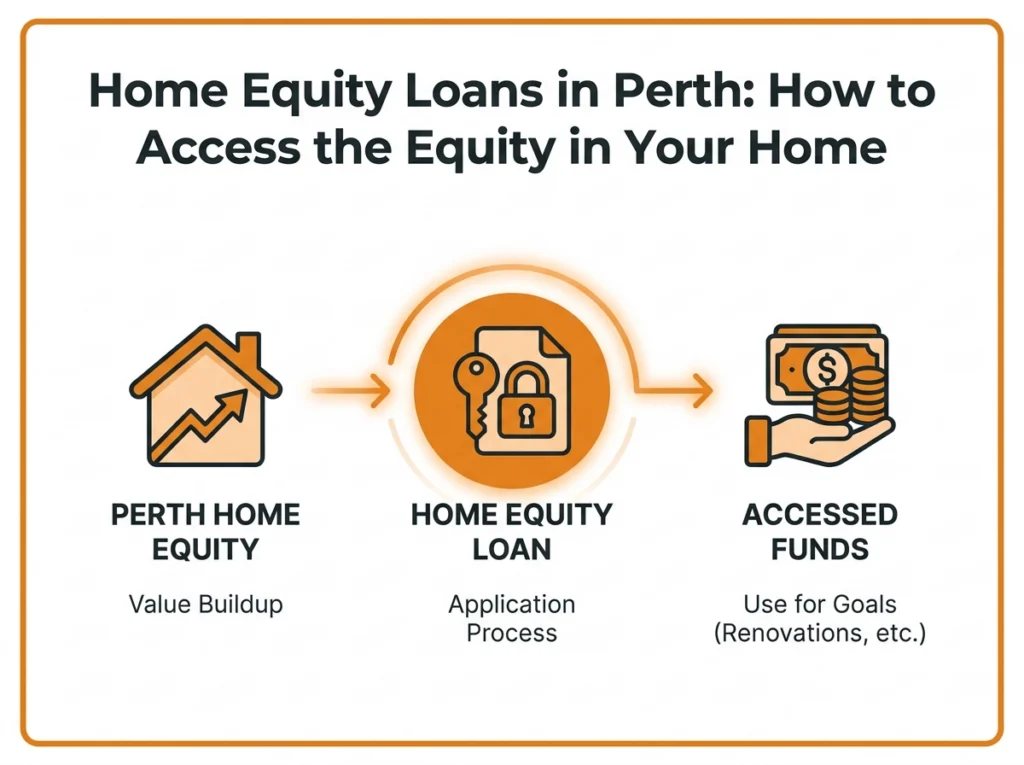
If you’ve owned your Perth home for a few years, a home equity loan can be a practical way to access the gap between what your property is worth and what you still owe, usually through a refinance or loan increase. That gap is your equity, and it can be one of the more useful financial tools available to homeowners. Perth homeowners use it to renovate, invest, consolidate debt or buy their next home before selling the current one.
This guide explains what a home equity loan actually is in Australia, how much you might realistically be able to access, and what to weigh up before you do. It’s not about chasing the lowest rate. It’s about understanding your options.
A home equity loan, sometimes called an equity home loan, lets you borrow against the value you’ve built up in your property. This is most commonly done through a cash-out refinance or a loan increase with your existing lender. Most Australian lenders allow homeowners to access equity up to 80% of their property’s assessed value without paying Lenders Mortgage Insurance, though this threshold varies by lender and can change over time. Usable equity is generally calculated by applying that 80% figure to your property’s current value and subtracting what you still owe.
Perth homeowners commonly use accessed equity for renovations, investment property deposits, debt consolidation or bridging finance between properties. Accessing equity increases your loan balance and, in most cases, your repayments, so it’s worth weighing this up against your longer-term goals before committing.
What Is a Home Equity Loan and How Does It Work?
In the United States, a “home equity loan” is often a separate loan product sitting behind your first mortgage. In Australia, it works differently. There’s typically no separate “equity loan” product. Instead, you access equity through your existing home loan, usually in one of two ways:
- Cash-out refinance. You refinance your home loan, either with your current lender or a new one, for a higher amount than you currently owe. The difference between your new loan and your old balance is paid to you as cash.
- Loan increase or top-up. If your current lender is happy with your position, you may be able to increase your existing loan or add a new split, without refinancing the whole thing.
Which option makes sense depends on your current interest rate, your lender’s policies and how much you’re looking to access. A mortgage broker can compare both routes across multiple lenders so you’re not limited to what one bank offers.
How Much Equity Can You Access?
Lenders typically assess equity against a loan-to-value ratio, often up to around 80% of your property’s current value before Lenders Mortgage Insurance applies, though policies vary and can change. To estimate usable equity, take the lender’s current lending threshold and subtract your remaining loan balance.
For example, a property valued at $700,000 with an 80% threshold gives a maximum loan amount of $560,000. If you owe $400,000, your usable equity is approximately $160,000, before accounting for costs and lender buffers.
A few things affect this in practice:
- Lenders assess the property’s current value, not what you paid for it. A formal valuation is usually required.
- You still need to pass a full credit and serviceability assessment. Having equity available doesn’t mean a lender will automatically approve the increase. Pre-approval is an indication only, and final approval depends on valuation and a full assessment at the time of application.
- Some lenders keep a buffer and won’t lend against every dollar of equity you appear to have.
What Perth Homeowners Use Home Equity For
How you access your equity often depends on what you’re trying to achieve. The most common reasons we see include:
- Renovating. Using equity instead of savings to fund a kitchen, bathroom or extension.
- Buying an investment property. Using existing equity as a deposit, rather than saving one from scratch, once your loan-to-value ratio allows for it. Trent Fleskens covers this specific strategy, sourced from a Perth Property Show discussion, in our guide to using equity for an investment property deposit.
- Consolidating higher-interest debt. Rolling credit cards or personal loans into a home loan can simplify repayments, though it comes with trade-offs worth understanding properly.
- Bridging to your next home.Accessing equity to help fund a purchase before your current property sells.
- Building a cash buffer. For education costs, a life event, or simply having funds available.
Each of these has its own considerations, and the right approach depends on your goals, your equity position and your risk appetite. If you’re not sure which applies to you, our Perth mortgage brokers can talk it through with no obligation.
Home Equity Loan vs “Equity Release”: Two Different Things
You’ll sometimes see the term “equity release” used online, and it’s worth knowing it can mean two quite different things.
In Australia, “equity release” most commonly refers to a reverse mortgage. This is a specific loan product typically aimed at homeowners aged 60 and over who want to access equity without making regular repayments. MoneySmart’s guide to reverse mortgages explains how this product works and who it’s generally designed for.
That’s a different product to what this guide covers. If you’re a homeowner looking to access equity through a standard refinance or loan increase, “home equity loan” is the more accurate term for what you’re after, not “equity release”. If you’re unsure which applies to your situation, it’s worth clarifying with a broker before you start comparing products.
Why Many Perth Homeowners Have More Equity Than They Realise
Property values across Perth and the wider Western Australia market have moved considerably in recent years, and many homeowners haven’t revisited what their property might be worth today. Recent REIWA market data has pointed to a strong Perth Metro market, but exact median figures move as new sales settle, so treat public figures as a snapshot rather than a fixed valuation for your property.
Growth hasn’t been even across the board. Inner and coastal suburbs like Cottesloe and South Perth have historically commanded a premium. Growth corridors such as Baldivis and Ellenbrook have also seen strong value gains over the past few years.
If you bought several years ago and haven’t checked your property’s current value, it’s worth getting an up-to-date estimate before assuming how much equity you have. Values vary by suburb and property type, so a broker or valuer can give you a clearer picture than a general market figure.
What to Consider Before You Access Your Equity
Putting your equity to work can be useful, but it’s still your home securing the loan, so it deserves a clear-eyed look at the trade-offs.
- It increases your loan balance. Accessing equity means borrowing more, which usually means higher repayments. Understand the ongoing cost before deciding anything.
- A longer loan term can cost more overall. Spreading a smaller debt over a much longer mortgage term can mean paying more in total interest, even if the rate is lower than what you were paying elsewhere.
- Property values can also fall. Equity isn’t fixed. A downturn in the market can reduce the equity available to you.
- Using equity for investment can mean cross-collateralisation, where your home and the new property are both used as security. This isn’t right for everyone, and a broker should walk you through the alternatives.
Our page on investment loans explains how lenders assess an investment purchase, including how much of the rent they count.
A Worked Example (Illustrative Only)
Say a Perth homeowner’s property is valued at $750,000 and they owe $420,000 on their mortgage. At an 80% lending threshold, their maximum loan amount would be $600,000, leaving usable equity of approximately $180,000 before costs and lender buffers.
If they wanted to access $60,000 for a renovation, their loan balance would increase from $420,000 to $480,000. Depending on the interest rate and remaining loan term, this would likely increase their monthly repayments. A broker can model the actual repayment impact based on current rates and your specific loan structure.
This example is illustrative only. Actual outcomes depend on your lender, your interest rate, your loan term and your individual financial circumstances.
How to Access Your Home Equity: The Process
- Tell us about your situation.A broker will ask about your property, your current loan and what you’re hoping to achieve.
- We assess what’s realistic. This includes an estimate of your usable equity, a comparison of lenders, and an honest view of whether it’s the right move.
- You move forward with confidence.If it stacks up, your broker handles the application and paperwork through to settlement.
Ready to See What Your Equity Could Do?
If you’re wondering how much equity you could access in your Perth home, speak with Strategic Mortgages Perth. We can walk you through the numbers with no obligation and compare equity access options across our lender panel to find what’s realistic for your situation.
Frequently Asked Questions
What is a home equity loan?
A home equity loan is a way of borrowing against the value you’ve built up in your property, usually through a cash-out refinance or a loan increase. In Australia, it’s typically not a separate loan product. It’s an increase to your existing home loan.
How much equity can I access in my home?
Many lenders may allow you to borrow up to around 80% of your property’s current value without paying Lenders Mortgage Insurance, though policies vary and can change. Your usable equity is generally this amount minus your remaining loan balance, though it varies by lender and is subject to a full credit assessment.
Do I have to refinance to access my home equity?
Not always. Depending on your lender and circumstances, you may be able to access equity through a loan increase or a separate loan split rather than refinancing your entire mortgage. A broker can help you find the cleanest option for your situation.
Is a home equity loan the same as equity release?
Not quite. In Australia, “equity release” usually refers to a reverse mortgage, a product generally aimed at homeowners aged 60 and over. A home equity loan, as covered in this guide, is accessed through a standard refinance or loan increase and is available to a broader range of homeowners.
What can I use my home equity for?
Common uses include renovations, investment property deposits, consolidating higher-interest debt, and bridging finance between properties. What makes sense for you depends on your goals, your equity position and your broader financial circumstances.
Disclaimer: The information provided in this article is general in nature and does not constitute financial, tax, or legal advice. Individual circumstances vary. We recommend consulting with qualified professionals before making financial decisions.